
Why is ‘Learning by Doing’ Becoming the New Education Standard?
If you are a parent to school-going kids, you must have noticed a sudden yet massive shift in the pedagogy and curricula being followed at schools. Scan across the websites and brochures of the top schools in Noida, and you’ll increasingly come across words like ‘hands-on learning,’ ‘experiential learning,’ and ‘applied learning’.
What do you think has brought this change? Have you wondered why schools are replacing traditional learning methods with the ‘learning by doing’ approach? We’ve shared the key reasons behind this shift in this blog post today, so make sure you read till the end. It will help you understand what exactly the learning by doing approach is all about and why it is increasingly taking over as the new education standard.
What is ‘Learning by Doing?’
‘Learning by doing’ is slowly becoming one of the most talked-about education methodologies, but it isn’t what most people think it is. Some people mistakenly believe that this approach eliminates textbook learning and only encourages students to participate in activities that help them develop conceptual clarity.
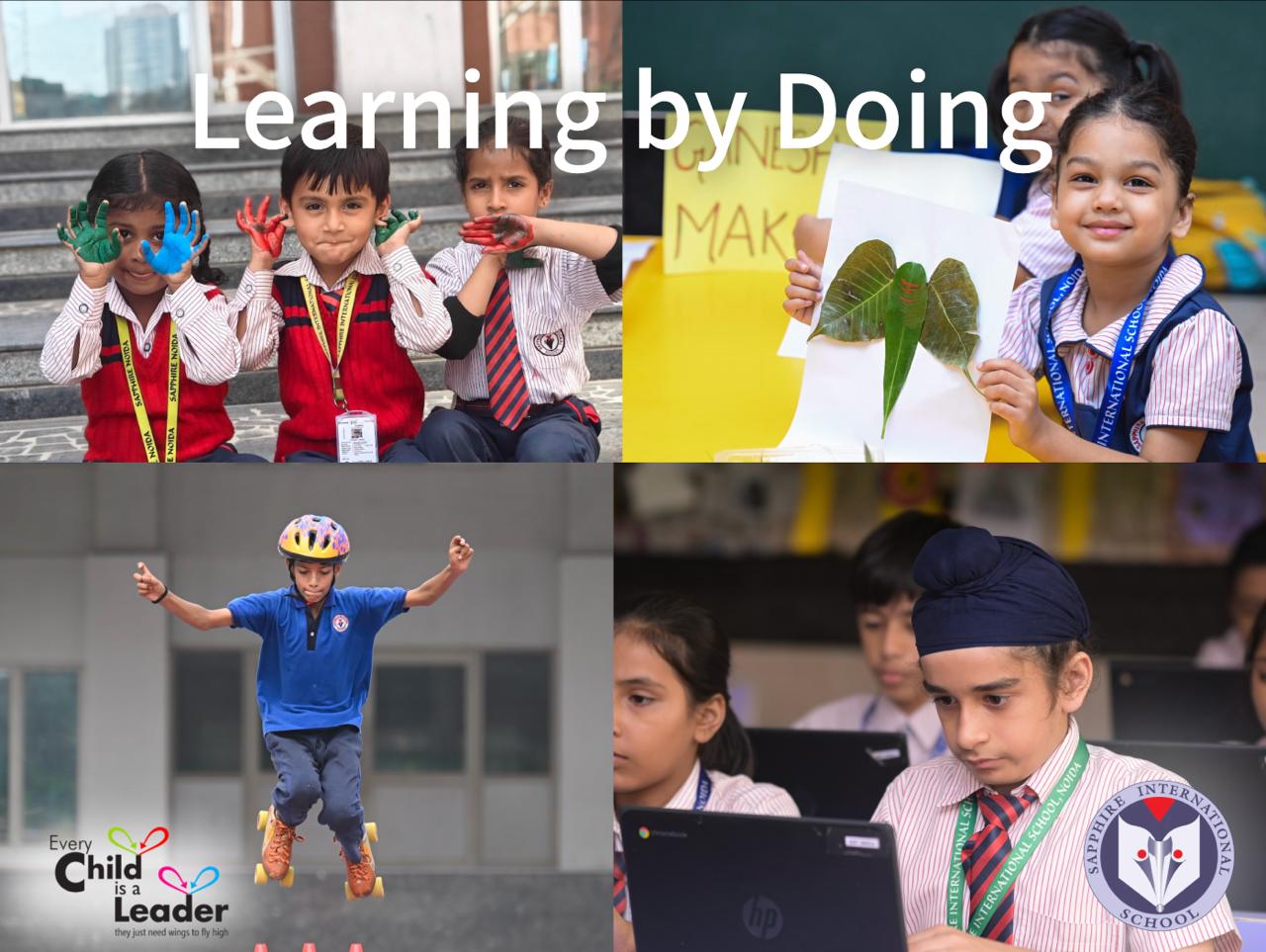
In reality, this method complements the conventional learning approach. It combines textbook learning and classroom lectures with hands-on activities, projects, and other experiential learning activities that help children apply in real life what they’ve learned in textbooks.
Here’s Why ‘Learning By Doing’ is Becoming the New Education Standard
The growing popularity of ‘learning by doing’ isn’t random. The following points explain why it has become the new education standard.
- Helps students move beyond memorising
If you look closely, you will notice that the best CBSE schools in Noida, or anywhere else for that matter, are no longer relying only on traditional learning methods because they encourage passive learning and rote memorisation.
When children begin to actively participate in experiments, projects, presentations, etc., related to the lessons they’re currently studying, they begin to develop a better conceptual clarity. It makes it easier for them to apply their learned knowledge in real life. It not only strengthens their academic knowledge, but also helps them develop numerous 21st-century skills in the process.
- Gives teachers immediate insights into student progress
Traditional teaching often reveals learning gaps only after examinations. However, if a child’s learning gaps are identified at a later stage, correcting them can be challenging and may take more time.
Instead, when students start interacting in classroom discussions or projects, their conceptual understanding becomes more visible. Teachers can use it to identify which students have fully understood the concepts and which are still struggling. They can then provide students with the much-needed personalised teaching support to better guide them.
- Makes complex subjects easier to understand
There are many academic concepts which cannot be fully understood by simply hearing a lecture on them or merely reading a textbook about them. It applies to complex scientific principles, mathematical ideas, and even historical events.
Hence, the best schools in Noida, including us at Sapphire International School, have started incorporating more hands-on experiments, role-play activities, simulations, and demonstrations to make complex concepts easier to understand. We also encourage active student participation in these activities to ensure every student benefits from this approach.
- Improves long-term information retention
It isn’t uncommon for children to forget lessons on the very same day they learn them. Many manage to remember information till examinations but then struggle to recall it after a few weeks.
It usually happens when learning is based on memorisation and other passive methods. However, when students actively engage with the information, it naturally sticks with them for longer.
Hence, if you want the learning to stay with your kids for longer, make sure you encourage them to study using the ‘learning by doing’ approach.
- Encourages learning through exploration and mistakes
You cannot remove trial and error from real learning. Unfortunately, many traditional classrooms still reward only correct answers and pay no attention to students taking effort to attempt answering the questions. This discourages children from experimenting or taking any intellectual risk. It can be, however, fixed by the ‘learning by doing’ approach.
Learning by doing creates an environment where mistakes become part of the learning process. This encourages children to freely analyse what went wrong. They can use this input to refine their approach and develop confidence in solving problems independently. It’s a skill that will help children far beyond their academic journey.
Conclusion
The modern world education landscape has already realised that the future doesn’t require individuals with memorised knowledge. It demands highly knowledgeable people who can apply their learning in real-world situations. It’s why we at Sapphire International School, positioned among the top schools in Noida, never restrict learning to textbooks alone.
We’re focused on nurturing future-ready citizens who possess the skills, mindset, and behaviour that’ll come to their aid in succeeding in life beyond school. We’ve intentionally created an experiential learning environment where students feel free to express their creative side, think critically, and lead confidently.
Our school uses age-appropriate hands-on learning activities to deliver the best results. A quick look at our learning stages will give you more clarity about our approach to ‘learning by doing.’