Why Learning Should Prepare Children for Life Beyond the Classroom
Key Highlights
- Education should prepare children for real-world situations, not only examinations.
- Practical experiences can strengthen problem-solving and decision-making abilities.
- Communication, collaboration, creativity, and leadership are essential future skills.
- Technology can make learning more interactive, relevant, and independent.
Introduction
What should children truly gain from their years at school?
The answer goes beyond marks, grades, and academic achievements. At Sapphire International School, one of the first environments where children learn how to interact with different people, manage responsibilities, express opinions, handle challenges, and make decisions. These experiences gradually shape the way they approach the world.
A meaningful education therefore needs to prepare students for situations they may encounter outside the classroom. Best School in Noida whether it is solving an unfamiliar problem, working as part of a team, speaking confidently, managing time, or responding positively to failure, these abilities become increasingly important as children grow.
From Knowing to Doing
Knowledge becomes more meaningful when children know how to use it.
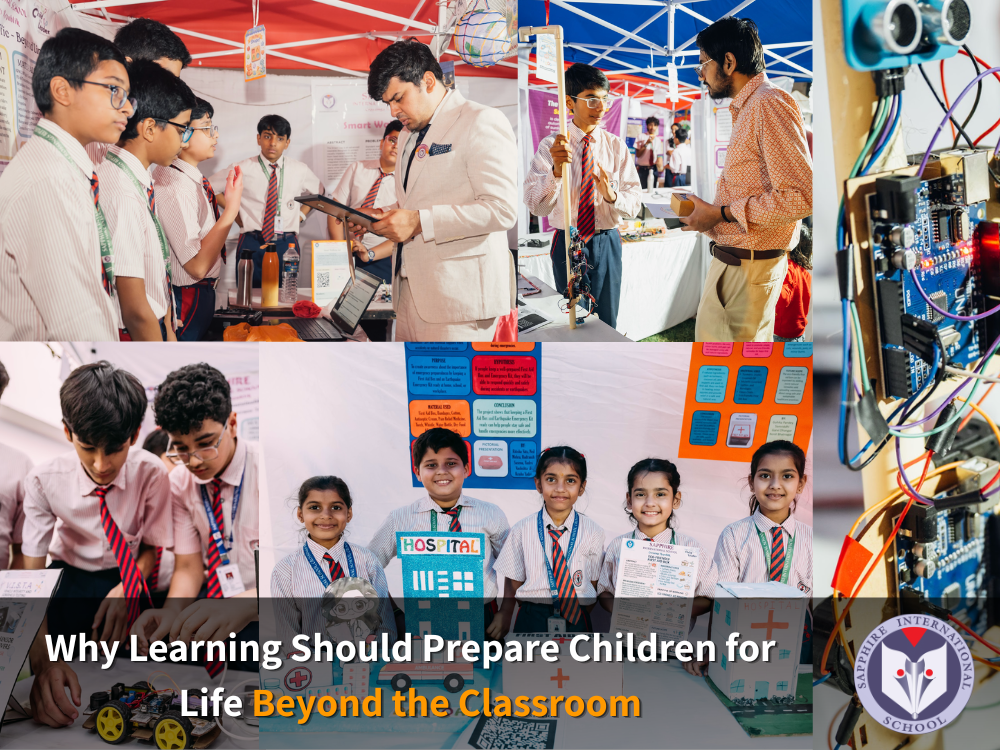
A student may understand a scientific concept from a textbook, but experimentation can help them understand how that concept works in practice. Similarly, mathematical learning can become more relevant when children use numbers for planning, measuring, budgeting, or analysing information.
This transition from knowing to doing encourages curiosity and independent thinking. Activities such as projects, experiments, presentations, discussions, competitions, sports, and community initiatives allow students to take an active role in their learning.
Such experiences also teach children an important lesson: mistakes are not necessarily failures. They can be opportunities to rethink an approach, identify gaps, and try again.
Skills That Stay Beyond School
Communication
Being able to express an idea clearly is useful in almost every area of life. Classroom discussions, presentations, storytelling, debates, and group activities can help students become more comfortable communicating with others.
Collaboration
The real world rarely works in isolation. Children need to understand how to listen, share responsibilities, respect different perspectives, and contribute towards a common goal.
Problem-Solving
Not every challenge comes with a textbook answer. Encouraging students to ask questions, investigate possibilities, and develop their own solutions can strengthen their ability to approach unfamiliar situations.
Adaptability
The world continues to change through technology, new careers, evolving social environments, and emerging challenges. Students who learn to adapt and remain curious are better prepared to navigate uncertainty.
Where Leadership Begins
Leadership does not begin with a title.
For a child, leadership can simply mean taking responsibility for a classroom activity, helping a teammate, presenting an idea, organising a project, or having the confidence to make an informed decision.
The philosophy of “Every Child is a Leader” reflects this belief. The institution’s educational journey, which began with its early-years campus in 2003, has placed emphasis on recognising individual strengths and creating opportunities for children to develop confidence, curiosity, creativity, and leadership.
Learning in a Digital World
Technology is now an important part of children’s everyday lives. Education therefore needs to help students understand not just how to use technology but how to use it responsibly and creatively.
Digital resources can support research, collaboration, presentations, innovation, and independent exploration. When technology is combined with strong guidance from educators, it can encourage children to become creators and problem-solvers rather than passive consumers.
The institution’s stated approach includes technology integration and an entrepreneurial mindset, reflecting the importance of preparing students for a rapidly changing environment.
Values Make Learning Meaningful
A child may possess excellent academic knowledge, but education becomes more complete when it is accompanied by empathy, integrity, resilience, respect, and responsibility.
Values influence how children treat others, respond to difficulties, use opportunities, and contribute to their communities. Schools can nurture these qualities through everyday interactions, collaborative activities, community engagement, sports, creative pursuits, and responsible decision-making.
The institution’s vision of developing future-ready global citizens who remain rooted in values highlights the importance of balancing modern skills with strong character.
Every Child Needs a Different Path
Children do not learn in exactly the same way or progress at the same pace.
Some may excel academically, while others may demonstrate exceptional abilities in sports, music, art, technology, communication, leadership, or problem-solving. A supportive learning environment recognises these differences instead of measuring every child through a single definition of success.
The “No Child Left Behind” philosophy emphasises providing students with the guidance, support, and opportunities needed to progress. This kind of approach can help children recognise their individual strengths while working on areas where they need additional support.
Parents, Teachers and the Wider Community
Education becomes stronger when learning is not restricted to the school campus.
Teachers provide academic guidance and mentorship, parents reinforce learning and values at home, while the wider community offers opportunities for children to understand real-world responsibilities.
The institution’s approach describes parents as partners and the community as collaborators. This creates a broader ecosystem where children can connect their education with everyday experiences.
Conclusion
The most valuable lessons children learn are not always found between the pages of a textbook.
At Sapphire International School, learning how to communicate, cooperate, think independently, handle failure, make decisions, accept responsibility, and remain curious can influence a child’s journey long after formal schooling ends.
This is what makes holistic education increasingly important. A Best School in Noida should not only provide a strong academic foundation but also create opportunities for children to discover who they are, understand the world around them, and develop the confidence to participate in it.
FAQs
- Why should education go beyond academic learning?
Because children also need communication, problem-solving, collaboration, confidence, and decision-making skills for life beyond school. - How does experiential learning help children?
It allows students to apply concepts through practical activities, projects, experiments, and real-world situations. - Why are leadership opportunities important for students?
They can develop independence, confidence, accountability, communication, and initiative. - What role does technology play in modern education?
Technology can support research, creativity, collaboration, independent learning, and digital skills when used purposefully. - How can schools develop strong values in children?
Values can be nurtured through everyday interactions, teamwork, community activities, responsible decision-making, and positive role modelling. - What should parents look for in a holistic school?
Parents can consider academics, practical learning, student wellbeing, leadership opportunities, values, extracurricular activities, technology, and individual student support.
[…] often test knowledge months after learning a topic. So if your kids learn something once and then don’t revise it, their understanding […]